Somebody has spent an evening making a door play a ridiculous noise. Somebody else has worked out how to stop a volunteer copying the same information into three different places every week. I want both of those people in the room.
That is the starting point for AutomateNI: a Northern Ireland community where people can bring the things they have tried to automate and talk about how they work. Code, hardware, software, useful little jobs, completely unnecessary experiments. The interesting bit is usually the reason someone bothered to make the thing in the first place.
The project you nearly did not mention
It is easy to talk yourself out of sharing something small. You wrote a few lines to rename some files; someone else is building an entire system. Yours took an hour. Theirs has a logo. You decide you have nothing much to show.
Except the file problem might be exactly what another person has been putting up with for months. They may not need your whole script. They might only need to see that a preview of the proposed names is possible before anything changes. That is a useful evening for them, and it does not require you to turn a folder utility into a business.
There is something lovely about seeing the particular annoyance that made somebody start building. A button placed where a person can actually reach it. A display with numbers big enough to read from the other side of the kitchen. The stubborn little exception that made an apparently simple task a pain. Those details give people a way into a project, including people who would struggle to follow a screen full of code.
An explanation can leave things unfinished, too. If the first version works until you press the button twice, show that. Someone may know why. They may have made the same mistake. Either way, there is a better conversation to be had than pretending everything went perfectly.
A room people can find their way into
Through Farset Labs, I have helped revive ELI5, the Explain Like I’m 5 lightning-talk series, and hosted maker nights. That feeds an interest that runs through AutomateNI: giving people somewhere to be interested in things together.
The room matters as much as the programme. Imagine arriving on your own, knowing nobody, with a laptop full of something you are still embarrassed to call a project. An invitation that says “all levels welcome” does very little if every explanation assumes you already know the tools and everyone immediately disappears into conversations with their friends.
For AutomateNI, that means asking speakers to explain what their project does before naming everything it runs on. It means making space for questions that begin with “sorry, what does that mean?” It also means treating the person who knows the actual job as someone worth listening to. A volunteer who has handled a rota for years may spot a problem that two enthusiastic programmers have completely missed.
There is a balance to get right. Experienced builders should have room to get into the details, and newcomers should have enough context to stay with them. We will have to keep paying attention to that as the nights develop. Putting “community” in the name does not settle it.
The robot is allowed to be silly
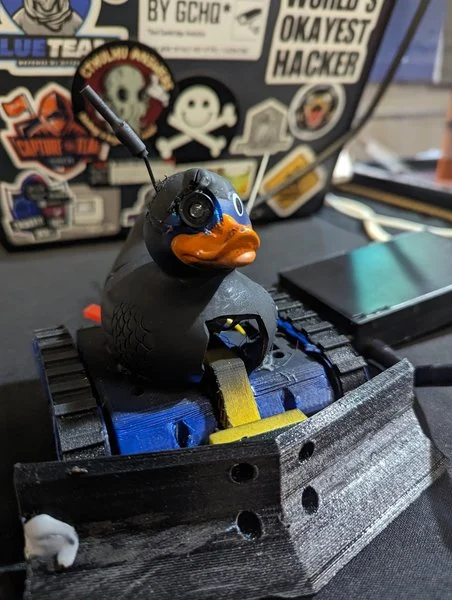
The small robot in the photograph at the top of this article comes from Farset Labs’ July 2024 update, which includes its Hacker Battle Bots activity. It is a useful reminder that making things can be a thoroughly enjoyable use of an evening without a productivity claim attached.
A door sound effect might teach its builder about timing, device states and the surprisingly important question of how often a joke should repeat. Once is funny. Every time somebody moves near the sensor for the next twenty minutes is a different proposition. An off switch becomes part of the design fairly quickly.
The same curiosity can lead somewhere practical. You notice that the sensor sends the same event twice, or that a display still looks convincing after its connection has died. Those problems turn up in workplace software as well. A physical device makes them unusually easy to see: the light is on, the action happened twice, the thing is now doing something you did not intend.
There is no need to justify a playful build by claiming it will eventually save somebody money. Learning how it behaves is enough. Bring the useful version if you have one, and bring the absurd version if that is what persuaded you to spend Saturday with a soldering iron.
Sources: Farset Labs: Return of the Mavericks.
Where AI fits
AI can be part of a good project. A model might help transcribe a voice note or sort a messy input before a person checks it. If that is what you are experimenting with, show what it helps with and an example it gets wrong. Both are worth seeing.
A timer, a comparison or a switch may be all another project needs. Home Assistant describes automations through triggers, conditions and actions; Node-RED lets you follow messages through a flow. You can get a long way by making those ordinary steps understandable. There is no requirement to put a model in the middle.
That breadth needs to show up in what we invite and publish. If every example on the website involves AI, saying “we cover more than AI” will not do much good. Hardware projects, small scripts, accessibility ideas and volunteer workflows need actual space in the programme. If you are working on one, please send it in. You are helping shape what people understand this community to be.
Sources: Home Assistant: understanding automations, Node-RED: working with messages.
Come along, show something, lend a hand
Automate and Tell is the regular show-and-tell format: short demos with time to ask about them afterwards. Workshops give people time to work on an automation during the event, while Talks focus on practical cases, industry and automation in Northern Ireland. The intention is to keep community nights free wherever possible.
The first nights are still being planned. Dates, venues and booking details will appear on the event pages once confirmed. You can ask for an email when there is a date without having a project, a pitch or a job title ready.
AutomateNI is founded and organised by me, Callum Janes, with Galvia Digital as founding supporter. Practical support can help pay for a room or feed the people in it. Community updates remain AutomateNI updates; signing up does not add you to a supporter’s marketing list.
If you have something to share, start with a rough description. Tell us what starts it, what happens and which bit you are still figuring out. You can contribute a build note without giving a talk, or offer to help check a guide or welcome people on a night. And if you are still at the stage of being interested in somebody else’s gloriously unnecessary gadget, that is a perfectly good reason to come along.
Sources and further reading
- Farset Labs: Return of the Mavericks. Farset’s own account of its maker activities and projects, published July 2024.
- Home Assistant: understanding automations. A practical introduction to triggers, conditions and actions.
- Node-RED: working with messages. Inspecting the information that travels through a flow.